- Introduction
- Searching for a volunteering opportunity abroad
- The belief system: The White Saviour Paradigm
- The trap: the Poverty Paradox in the context of voluntourism
- Orphanage Tourism. The most damaging voluntourism business model
- Checklist to search for volunteering opportunities abroad
- Trustworthy agencies
- Bibliography
As more experiences become exponentially more accessible and mainstream they seem to lose value. Consequently there is a constant hunt for something somewhat more ‘authentic’. Neoliberalism knows that and will adapt to feed that need to live more ethically. We are a society becoming more conscious every year about how we consume, how we nurture our bodies, what happens to our waste, our digital information, what our taxes are not covering, how the language we use might misrepresent some demographics or even discriminate against them. Business adapts to this trend seeking both authenticity and morality. But, can authenticity remain when destinations or experiences become mainstream? Can acts of altruism remain ethical if there is an industry producing them for profit?
Icons of revolution like George Orwell or Karl Marx now seem biased, sexist and racist. Statements, jokes or brands that stood for something only a few years ago now produce some genuine cringe. We never seem to get it right enough, be humble enough, sustainable enough, conscious enough, honest enough in our materialistic capitalist societies. No wonder youth today are becoming more and more conscious and grow up hoping to be the ones who will make a real difference by going abroad where they can scape the pressures of our growingly neoliberal societies.
I have also volunteered abroad to a less wealthy, less developed and less white country. I too grew up with images of poverty and the thought of coming back from volunteering in an African tribe having a new found sense of reality and purpose. Again, ‘coming back’. This is the level of commitment we were told was enough to make a difference, to feel changed and to forever have that tap on our backs. Now that illusion and need to contribute has been recognised as a commercial opportunity and become one of the fastest growing sectors within the tourism industry. So-called volunteering experiences where a person without experience can teach, or build a school that is destined to be knocked down and by locals overnight so that the next bus-load of tourists can have a fulfilling experience rebuilding it (Godin, 2021). This is called voluntourism and it is targeting young unskilled tourists who want an opportunity to make a difference and are told they qualify with just the willingness to do it, and pay money for the privilege of doing so.
In this article I outline the tip of the iceberg of the growing industry of voluntourism, combining travelling with the “opportunity to connect with locals and make a contribution”. The scam of some voluntourism organisations, the white saviour paradigm that feeds from, why this strategy for development is failing and a useful checklist to evaluate whether an organisation’s priorities are the experience of tourists over the community they claim to serve.
Searching for a volunteering opportunity abroad
I decided time was a better donation than money when I was fundraising for the local organisation of an international NGO through a Dutch company in Barcelona at the age of 17. I applied to volunteer abroad when I was starting my degree at the age of 22 in Brighton and I was writing funding application for local charities in East Sussex. I felt that my job was rather enabling the circulation of money from wealthy pockets to other wealthy hands claiming to help less fortunate people in their community while not inviting them to be at the table discussing how to spend the money it was supposed to help them.
When I began researching my time volunteering abroad, the variety of choices was overwhelming. Luckily by the time I decided to bite the bullet and volunteer, I had already gained some experience, being one year into my degree and having been able to contact ICYE (Inter-Cultural Youth Exchange) to guide me. It is doubtful whether I would have done the assessment encouraged in this article back then, as I was completely oblivious to the fact this could even be something to capitalise on. I naively thought it impossible that a charity could be a scam. But surprise surprise, this is the world we live in. There are many, many scams. And those young people who are trying to live by making all the right choices and being the most ethical version of themselves are pretty attractive victims to the voluntourism industry, due precisely to their idealism and naivete, and sincere desire to be more ethical, healthier, more sustainable, and more selfless at least in appearance.
I knew I wanted to go somewhere where I spoke the language, in order to be as helpful as possible. When I learned that the Instituto Poblano de las Mujeres (IPM, ‘Pueblan Women’s Institute’) in Mexico were open for the first time to receive an international volunteer, I had no doubt I wanted to apply. So I went for it, as well as taking on another project supporting the girls at Casa de Asis (a catholic orphanage) with their homework after school and teaching English. I did not do any assessment at the time but I was lucky enough to have come across two roles that didn’t fit any of the keys that would now turn the value of my experience into a shameful one. However, I am fully aware I was moved by the same romanticisation that many young people volunteering fall for. When I was confronted by a friend with the notion of the ‘party white girls’ going to Mexico to volunteer and go wild, I was genuinely taken by surprise. I had never thought such a thing was possible…this is very much how naive and full of good intentions I was. This is how vulnerable young people falling for orphanage tourism can be at the age of 18.
Since my experience as a formally unqualified volunteer abroad, the investment in this industry has doubled. From gaps in organisations that could fit an international volunteer to a whole industry dedicated to alter the lives of impoverished communities to fabricate experiences for us feeding the white saviour paradigm at the cost of a fast-growing and popular sector such as orphanage tourism.
The belief system: The White Saviour Paradigm
Volunteering is an excellent opportunity to build strong communities through the practice of compassion and generosity by which to raise awareness, give a megaphone to voices otherwise unheard and allow individuals to become role models in their own communities. However, the rate of community volunteering is decreasing and shifting from a trend of regular participation with one charity volunteers would feel strongly towards, to occasional unpaid work for sporadic projects in different organisations. Some charities rely on volunteers to develop their projects, and use a reliable pool of experienced volunteers to organise projects.
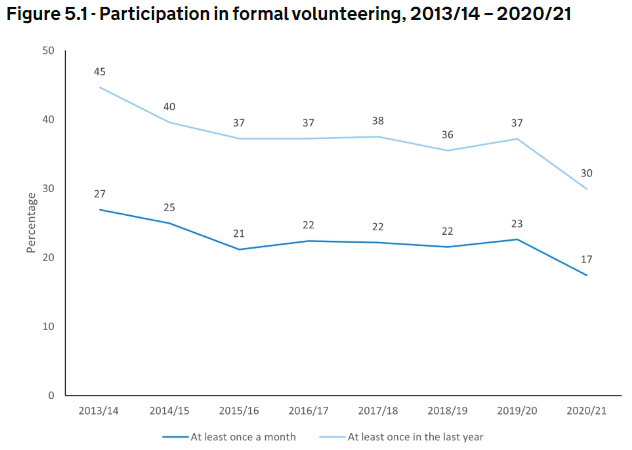
The trend shows not only are there now fewer volunteers working in their communities, but they donate less of their time and are far less committed to a single charity (Gov.uk, 2022). Contrarily, the industry of voluntourism is now worth over $2 billion (Bansal, 2021) and especially that of orphanage volunteering abroad is expanding fast. A recent study shows how broad internet searches to ‘volunteer abroad’ lead users to signing up for orphanage placements with convincing marketing, persuading them that they are being recruited without intermediates, even if that was not their original intention. (Siedel, 2019)
Many organisations seek to convince unskilled teenagers fresh out of secondary education that they can make a contribution, help poor people, have a life changing experience and conveniently combine it with the opportunity to travel abroad, add skills to their CV and take pictures with smiley darker children where the volunteers look like the white saviour, bringing joy. These students are often expected to pay around a thousand pounds/dollars/euro per week, for the pleasure of being seen to alleviate the suffering of other people and gain experience to boost their professional and academic eligibility.
This is not to seek to delegitimise the work or many organisations and skilled volunteers who travel abroad to offer their time and professional expertise for no pay and often returning to the same project. This text is focussed on the growing industry of volunteering holidays where westerners pay to travel to a poorer country to offer some manual labour for free, performing roles that they are not qualified for, such as spending a couple of weeks building a school, and taking jobs that locals could be paid to do. This industry is perpetuating a system of sympathy tourism instead of empathy based programmes. In other words, a worldview founded on sympathetic pity more than the experience of learning through empathy.
In these purchasable experiences the product is the short term outcome of the volunteer over the long term impact in the community they travel to. There are plenty of organisations operating with qualified doctors and nurses that are perfectly legitimate, opportunities to travel abroad building eco houses being taught new techniques or chances to live in beautiful locations in projects helping protect habitats. This article is not aimed at any of those initiatives, but rather at the fabrication of experiences promising to make a real change overseas in the surprisingly short amount of time of 2 to 3 weeks. Who is benefiting from these trips? Whose lives are they supposed to transform? Are we creating a dependency for more aid to feed this saviour holiday?
The success and expansion of the voluntourism industry exposes how embedded and ignorant western narratives are about the destination country. A plot where even without any training we would be equally or more qualified than a local to build a school or teach in it. A fiction reinforced by a western view of themselves as modern and progressive while those to be helped are traditional, religious and exotic; we are creators of knowledge while they are passive receivers; we are solid democracies while they have corrupt governments, we are producers of wealth while they have high rates of unemployment; we are efficient and they are lazy; we have a rich history while they are backwards; the problems in our countries are complex while theirs are simple, a mere lack of resources. So it is easy to send the message that even a 17 or 18 year old can make a contribution there more so than they could in their own countries, where teaching darker kids has more glamour than supporting isolated elderly in their communities.
The trap: the Poverty Paradox in the context of voluntourism
In this fiction of westernised ideas of development, we have the expertise and they are defined by what they lack and thus aid is focussed on their weaknesses providing short term supplies rather than venturing in innovative long term approaches rooted in their strengths. If we only focus on poverty, we lose sight of the goal of prosperity. We simplify the issue as a lack of resources, lack of clean water, lack of schools, lack of food… Thus the solution that is predicated is based on pushing those resources into that community. This is harmful because this strategy makes those they say to help dependant.
Furthermore, when we attempt to solve their problems through this lens, we are not allowing space for those communities to be sovereign, learning from their mistakes and implementing answers to their problems. And hence trigger a very damaging mindset, external locus control. When someone or a group of people are not allowed to apply their own solutions, test them and learn from them individually or collectively, they will believe that the results, whether it is failure or success, are out of their control. Instead of empowerment, we generate helplessness reinforcing that white saviour paradigm and an unequal relationship between nations that strengthen western dominance and drives poorer nations further away from achieving self-sufficiency.
We know that the end of poverty does not equal the end of struggle, people in first world countries suffer too. Thus, imposing western ideals of development onto allegedly impoverished communities is nonetheless paradoxical. Our economies are the ones enslaving those countries for cheap production of short life goods generated to feed our lifestyle of excess consumerism where a growing number of the population is in some financial debt and we are contributing greatly to climate change.
‘International Aid interventions are more often about us, a celebration of who we are and who we think we are’ (Chishti, 2016) further exemplifying the paradox of neoliberalism where, while the funds and organisations dedicated to international aid keep increasing, the gap between the wealthiest and poorest countries has only grown.
Orphanage Tourism. The most damaging voluntourism business model
The testimonies of international volunteers at orphanages are somewhere beyond disturbing. There are allegations that many of those organisations offering volunteering opportunities at orphanages in third world countries are inflating their capacity with an alleged 80% of children that are not orphans (ReThink Orphanages). These agencies and volunteers claim that less than a quarter of the children had no living parents, others would come from low income backgrounds or young families who would be approached by the organisation to offer them money to keep the flow of volunteers coming (ABTA).
Voluntourism is an expanding industry of which orphanage tourism is the fastest growing venture. There are more than 52 million international volunteer programmes and the number of private orphanages is on the rise. More than half a million orphanage volunteers per year work in Africa alone where in some countries such as Kenya, orphanages are privately run which favours the business models where tourists pay to visit (ReThink Orphanages, 2018) turning poverty into a tourist attraction. These orphanages get more funding than the local school but offer a less promising education if they are fundamentally run by young unskilled volunteers staying for short periods of time who can only offer a teaching of the same basics repeatedly (ReThink Orphanages, 2018).
Beyond the disturbance of the institutionalisation of infant poverty into this business venture fabricating a tourist attraction, there is the psychological harm that orphanage tourism causes to these children. In orphanages run by volunteers, these receive a constant flow of usually unskilled youth coming to stay for a short amount of time to leave again after a few weeks or months. Furthermore and with the best of intentions at heart, these volunteers would bring gifts for children who will never again be offered objects for free once they grow up. And most harmful of all, the children would grow to develop an attachment to loving caring volunteers who will leave soon to never go back repeating the trauma of abandonment over and over again. The amount of amassed/accumulated trauma neglected over unqualified, unsteady and short term support can do nothing but damage any developing human being (Cheer et al., 2020). Orphanage tourism feeds the short term economic benefit of selling a term limited experience to cause further harm to the people it advertises to help.
Checklist to search for volunteering opportunities abroad
There is no google search that will avoid the thousands of voluntourism agencies designed for economic gain over the long term goal because they will be accumulating more funding than a real NGO and will be able to count with SEO teams and strategic marketing. These organisations may not seem so evidently what they truly are but here is a good guide to judge them.
- First of all, consider whether you have any transferable skills to offer. If you don’t have qualifications to teach or build in your home country, why would you be able to do so abroad? What is behind that belief of superiority? Be critical, maybe you can offer something else like cleaning natural habitats and that way learning about a different ecosystem and the cultural connection to it in a different country. If you have no transferable skills but this organisation doesn’t require any, maybe that should be the first sign.
- If the agency does not require any qualifications, expertise or do thorough background checks, it is probably designed for your experience rather than the people it is pretending to help.
- If you have no qualifications or experience but want to go abroad and have the life changing grounding and real experience, maybe check educational programmes that can teach you their work there and go for an experience where you learn from them instead whether that is about their methods to build houses, their culture, their agriculture, cuisine, ancestral traditions and ceremonies or their education system.
- Are your skills useful for the project?
- If children and/or animal welfare is involved, check the project aligns with the local policy and guidelines.
- Do you speak the language?
- Does their website feature many pictures of children? If you would not take pictures of children that you work with in your home country, why do that abroad? Pictures with children should not be a souvenir. If the website of the organisation you are looking at looks more like EF than a list detailing their short and/or long term goals as an organisation, that should be a red flag.
- Check your privilege, can you be a role model in the community you go to? This can be hard to identify sometimes, it can come with a high level of discomfort admitting privilege, especially when that privilege comes from things out of your control.
- Volunteering abroad costs money, many people cannot afford to donate their time, let alone face the financial cost to travel to live elsewhere and work for free. Does this agency provide support to help people volunteering abroad who cannot afford to do so? Are they working to address this by engaging with marginalised communities?
- Do they have a long term project? If they offer volunteering experiences of less than a month, they do not have a long term approach to the subject they claim to care so much about. Surely we can make an enormous contribution once we are qualified to provide a service of real quality and need. However, that would be a project delivered over a long time period but most people looking to volunteer overseas, look into doing so for 2-3 weeks instead. Naturally, voluntourism agencies will keep that demand going to keep the business running whether or not they agree with it.
- Do they offer training and/or preparation prior to your trip?
- Is their sole form of funding through volunteers?
- Do they mention returning volunteers?
- Are they offering volunteering tasks that a local person could be paid to do? Volunteering can be a great way to raise awareness of what scapes the experience of your routine and privileged environment. But when 80% of volunteers are doing manual tasks that local residents could be employed to do themselves, there is a problem. Because then it becomes one sided, about westerners developing skills as opposed to being of use.
- Do they campaign to raise awareness about the matter they work on?
- A self-actualization experience that validates privilege is not justice. Going abroad to volunteer under those circumstances to realise our privilege creates enough change? Does it create awareness if we can leave so easily and that short experience contributes to our employability?
- Are the tasks of the role described in detail? Some agencies make development work look easy, like so much can be achieved in just two weeks of work. There are many testimonies of volunteers that fell for the scam of voluntourism and found themselves doing tasks they did not expect or felt ready to do.
- Do they mention what they have achieved so far? If they do have a long term approach, they will have goals and they should have achieved some already. Check if they have an annual report detailing their achievements and goals.
- A good strategy if you know the country you would like to travel to is looking into genuine charities directly there and contacting them for guidance.
Trustworthy agencies
ICYE (Inter-Cultural Youth Exchange) – For young people looking for an opportunity to volunteer abroad. ICYE is connected to many local projects overseas while staying with a host family.
List will be updated adding more agencies while research is conducted after the original post. Please keep checking for updates.
If you’ve had a good experience travelling abroad, please get in touch to recommend and add it to this list with a brief description of your experience.
Bibliography
ABTA, Orphanage Tourism (online) : https://www.abta.com/sustainability/human-rights/orphanage-tourism#:~:text=Common%20destinations%20for%20orphanage%20tourism,and%20solicit%20income%20from%20visitors
Bansal, S., 2021. ‘Do no harm: The dark side of voluntourism’. Driving Change (online) : https://drivingchange.org/do-no-harm-the-dark-side-of-voluntourism/
Better Care Network Netherlands, 2017. Orphanage Tourism: Report on a Survey Conducted in The Netherlands (online) https://www.bettercarenetwork.nl/content/17382/download/clnt/82403_Orphanage_Tourism_Report_on_a_Survey_conducted_in_the_Netherlands_-_BCNN_-_2018.pdf
Department for Digital, Culture, Media & Sport. GOV.UK. ‘Official Statistics. Volunteering and Charitable Giving – Community Life Survey 2020/21’ (online): https://www.gov.uk/government/statistics/community-life-survey-202021-volunteering-and-charitable-giving/volunteering-and-charitable-giving-community-life-survey-202021#motivators-and-barriers-to-volunteering
Godin, M. 2021. The Guardian. ‘Voluntourism: new book explores how volunteer trips harm rather than help’. (online): https://www.theguardian.com/global-development/2021/jun/10/voluntourism-new-book-explores-how-volunteer-trips-harm-rather-than-help
J.M. Cheer, et al. , 2020. Modern Day Slavery and Orphanage Tourism. CABI https://books.google.co.uk/books?hl=en&lr=&id=taLDDwAAQBAJ&oi=fnd&pg=PP1&dq=orphanage+tourism+80%25&ots=sbHIJjESlO&sig=hKP2ivD4VHe3hlEYD0IAmnyesNo#v=onepage&q=orphanage%20tourism%2080%25&f=false
Maliha Chishti , 2016 – https://www.youtube.com/watch?v=1xJ6p0B5V_A
Michigan Journal of Economics, 2022, ‘The Paradox of Voluntourism: How International Volunteering Impacts Host Communities’ (online): https://sites.lsa.umich.edu/mje/2022/01/22/the-paradox-of-voluntourism-how-international-volunteering-impacts-host-communities/
ReThink Orphanages, Facts and Figures about Orphanage Tourism. (online): https://rethinkorphanages.org/problem-orphanages/facts-and-figures-about-orphanage-tourism
ReThink Orphanages, 2018. Orphanage Tourism: Shedding light on the orphanage scam. (online) https://rethinkorphanages.org/problem-with-orphanage-tourism
Siedel, F, 2019. Adieu-Ark-B Marketing for ReThink Orphanages. ‘How big is the active demand for orphanage volunteering?’. (online): https://bettercarenetwork.org/sites/default/files/2021-01/Search-Volume-Study-Orphanage-Volunteering-AAB-Marketing-1.pdf
 Purposeful Disorientation